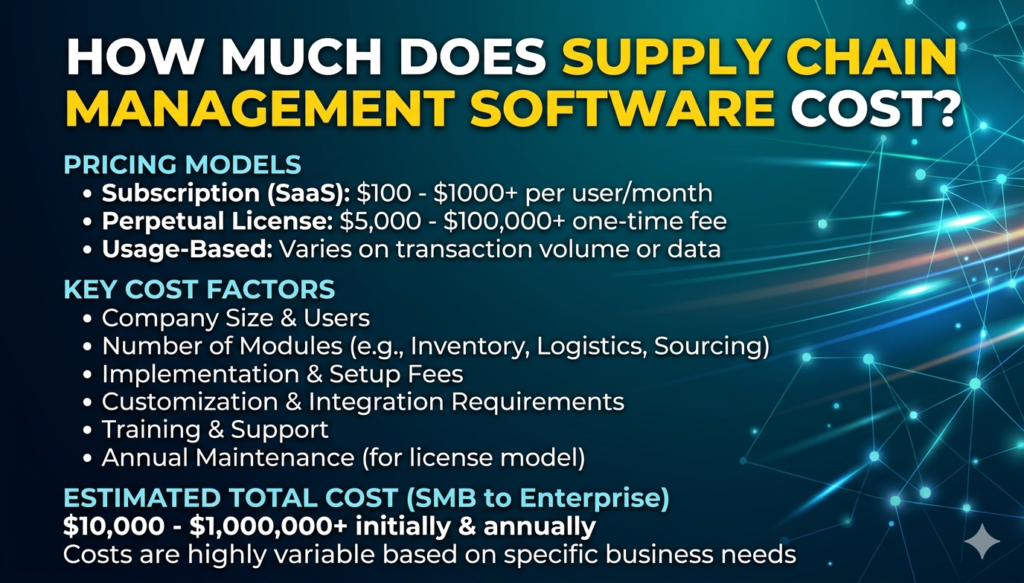
In today’s interconnected global economy, supply chains are no longer simple linear paths from manufacturer to customer. They are complex, data-driven ecosystems that demand speed, accuracy, and resilience. Organizations of all sizes are investing heavily in digital tools to manage procurement, inventory, logistics, and distribution. One of the most common and important questions decision-makers ask at the beginning of this journey is how much does supply chain management software cost.
This question does not have a single, universal answer. Instead, costs vary widely based on business size, industry, functional requirements, deployment model, and long-term strategic goals. Understanding these variables is essential for making an informed investment that delivers value rather than unexpected expenses. This article provides a deep, structured exploration of the cost factors, pricing models, and hidden considerations that influence the total investment in supply chain management software.
The Strategic Role of Supply Chain Management Software
Supply chain management software serves as the digital backbone of modern operations. It integrates data across suppliers, manufacturers, warehouses, distributors, and retailers into a unified system. By doing so, it enables better forecasting, real-time visibility, and coordinated decision-making.
When leaders explore how much does supply chain management software cost, they are often balancing two competing priorities: minimizing upfront expenses and maximizing long-term operational efficiency. The strategic role of the software means that cost should never be evaluated in isolation. Instead, it must be considered alongside expected improvements in service levels, inventory turnover, and risk mitigation.
Core Components That Influence Pricing
The total cost of supply chain software is directly tied to the components included in the system. Most platforms are modular, allowing businesses to select only what they need.
Common functional modules include demand planning, inventory management, warehouse management, transportation management, supplier relationship management, and analytics. Each additional module increases complexity and licensing fees. Therefore, when estimating how much does supply chain management software cost, organizations must first define which capabilities are essential versus optional.
Licensing Models and Their Cost Implications
One of the most significant pricing variables lies in the licensing structure. Vendors typically offer several models, each with distinct financial implications.
Per-user licensing charges a fee for every individual who accesses the system. This can be economical for small teams but expensive for large organizations. Transaction-based pricing depends on the volume of orders, shipments, or data processed. Subscription-based models, often billed monthly or annually, provide predictable expenses but may accumulate higher costs over time.
Understanding these structures is crucial when analyzing how much does supply chain management software cost, especially for businesses expecting rapid growth or seasonal demand fluctuations.
Cloud-Based vs On-Premise Deployment
Deployment choice has a major impact on both initial and ongoing costs. Cloud-based solutions typically require lower upfront investment, as they eliminate the need for in-house servers and extensive IT infrastructure. They also include maintenance and updates in the subscription fee. why is software bixiros.5a8 development process
On-premise systems, by contrast, involve higher initial costs for hardware, installation, and internal support teams. However, some organizations prefer them for greater control over data and customization. Evaluating how much does supply chain management software cost requires a clear comparison of these deployment models over a multi-year horizon.
Implementation and Integration Expenses
Software licensing is only one part of the total investment. Implementation costs can equal or even exceed the initial purchase price. These expenses include system configuration, data migration, process redesign, and integration with existing enterprise systems.
Complex supply chains with legacy systems often require custom integrations, which increase both cost and project duration. As a result, a realistic assessment of how much does supply chain management software cost must include professional services and internal resource allocation during implementation.
Customization and Scalability Considerations
No two supply chains operate exactly the same way. Customization allows software to align with specific workflows, regulatory requirements, and industry practices. However, customization also increases development time and costs.
Scalability is another key factor. A solution that meets current needs but cannot grow with the business may lead to costly replacements later. When calculating how much does supply chain management software cost, decision-makers should consider not only current requirements but also future expansion into new markets or product lines.
Training and Change Management Costs
Even the most advanced software delivers little value if users do not adopt it effectively. Training is therefore a critical, and often underestimated, cost component. Training programs may include vendor-led workshops, online courses, documentation, and ongoing support.
Change management efforts, such as communication campaigns and process alignment, also require time and resources. These human factors directly influence the real answer to how much does supply chain management software cost, as poor adoption can significantly reduce return on investment.
Ongoing Maintenance and Support
After implementation, ongoing costs continue in the form of maintenance, support, and system updates. Cloud solutions typically bundle these services into subscription fees, while on-premise systems may require separate maintenance contracts.
Support levels vary by vendor, with premium support offering faster response times and dedicated account managers at higher costs. Long-term budgeting for how much does supply chain management software cost must therefore account for these recurring expenses over the system’s lifecycle.
The Impact of Business Size and Industry
Company size plays a major role in determining software costs. Small and mid-sized businesses often require fewer modules, users, and integrations, resulting in lower overall investment. Large enterprises, especially those operating globally, face higher costs due to complexity and scale.
Industry also matters. Highly regulated sectors such as pharmaceuticals or aerospace may need specialized compliance features. Retail and e-commerce businesses prioritize real-time inventory and demand forecasting. These variations significantly influence how much does supply chain management software cost for different organizations.
Regional Factors and Market Differences
Geographic location can affect pricing through labor costs, regulatory requirements, and data hosting preferences. For example, companies operating in the United States may face different compliance and security standards compared to other regions, which can influence both implementation and ongoing costs.
Regional support availability and local partner ecosystems also play a role. These factors should be considered when assessing how much does supply chain management software cost in a specific market context.
Hidden Costs Often Overlooked
Beyond visible expenses, there are hidden costs that can catch organizations off guard. These include system downtime during transition, productivity loss during training, and additional consulting required to address unforeseen challenges.
Data quality issues can also increase costs if significant effort is needed to cleanse and standardize information before migration. A thorough evaluation of how much does supply chain management software cost must factor in these indirect but very real expenses.
Measuring Value Beyond the Price Tag
Focusing solely on cost can lead to suboptimal decisions. Instead, organizations should evaluate total value delivered. This includes reduced inventory holding costs, improved service levels, faster decision-making, and greater resilience to disruptions.
When viewed through this lens, the question of how much does supply chain management software cost becomes part of a broader discussion about return on investment, competitive advantage, and long-term sustainability.
Building a Realistic Budget and Business Case
Creating a strong business case requires aligning software investment with strategic objectives. This involves estimating not only costs but also quantifiable benefits over time.
Scenario planning can help compare different solutions and deployment models. By doing so, leaders gain a clearer, more accurate understanding of how much does supply chain management software cost relative to expected outcomes.
Future Trends Influencing Costs
Emerging technologies such as artificial intelligence, machine learning, and advanced analytics are reshaping supply chain software. While these features may increase initial costs, they also offer significant efficiency gains.
As vendors continue to innovate, pricing models may evolve to emphasize value-based outcomes rather than static licenses. Keeping an eye on these trends is essential when forecasting how much does supply chain management software cost in the coming years.
Conclusion
Determining the true cost of supply chain management software is a multifaceted process that extends far beyond a simple price quote. It involves understanding functional needs, deployment choices, implementation complexity, and long-term operational impact. The recurring question, how much does supply chain management software cost, can only be answered accurately when organizations take a holistic, strategic view.
By carefully analyzing both direct and indirect costs, considering future scalability, and focusing on value creation, businesses can make informed decisions that strengthen their supply chains and support sustainable growth. In an era defined by uncertainty and competition, the right investment in supply chain technology is not merely an expense—it is a critical enabler of resilience and success.