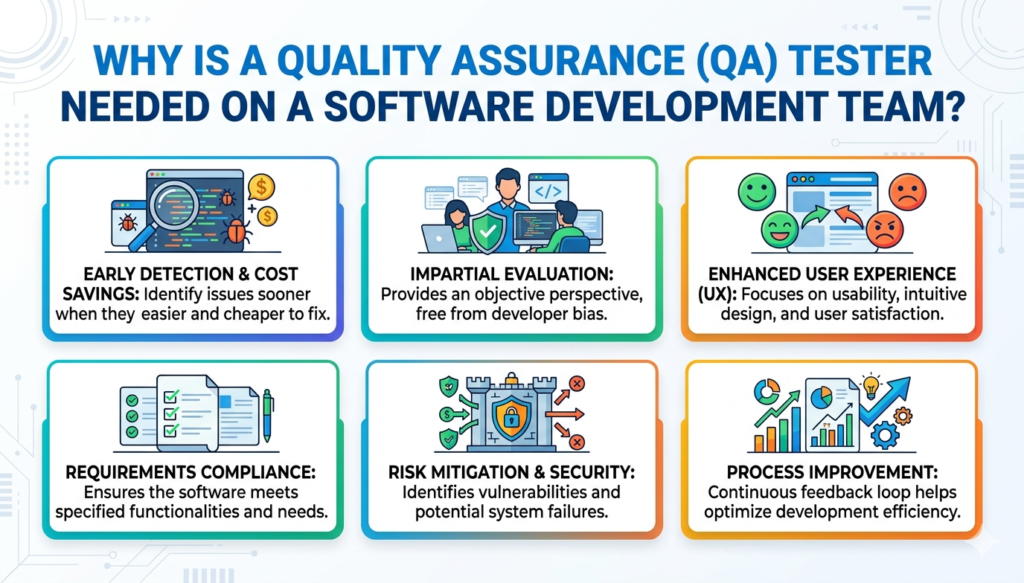
In today’s fast-paced digital environment, software products are expected to be reliable, secure, user-friendly, and continuously improving. Behind every successful application lies a complex collaboration of professionals working together to design, build, and refine digital solutions. Among these roles, quality assurance (QA) testers play a critical yet sometimes misunderstood part. Many stakeholders still question why is a quality assurance tester needed on a software development team? The answer lies in understanding how software quality directly impacts business success, user trust, and long-term sustainability.
Quality assurance is no longer a final checkpoint before release; it is an integrated discipline that supports the entire development lifecycle. QA testers act as advocates for the user, guardians of quality, and collaborators who help teams deliver stable and valuable products. This article explores the strategic importance of QA testers, their responsibilities, and the tangible value they bring to software development teams.
Understanding Quality Assurance in Software Development
Quality assurance in software development refers to the systematic process of ensuring that a product meets defined standards of quality before it reaches users. Unlike simple bug detection, QA encompasses planning, process improvement, risk assessment, and continuous monitoring. It aims to prevent defects rather than merely identify them after the fact.
A QA tester examines software from multiple perspectives: functionality, usability, performance, security, and compatibility. This holistic view helps uncover issues that developers, focused primarily on implementation, may overlook. When organizations ask why is a quality assurance tester needed on a software development team?, they are essentially questioning the value of structured oversight in a highly technical and creative process.
The Evolution of QA Roles
Historically, QA testers were involved only at the end of development, performing manual tests before launch. This approach often resulted in rushed fixes, delayed releases, and unresolved defects. Modern development methodologies such as Agile and DevOps have transformed the QA role into a proactive and collaborative function.
Today’s QA testers participate from the earliest stages of planning and design. They review requirements, contribute to user stories, and help define acceptance criteria. This early involvement reduces ambiguity and aligns development with user expectations. The evolving role demonstrates clearly why is a quality assurance tester needed on a software development team? because quality must be built in, not inspected in at the end.
Preventing Costly Errors Early
One of the most compelling reasons for having QA testers is cost prevention. Fixing a defect during the design or development phase is significantly cheaper than resolving it after deployment. Post-release bugs can lead to customer dissatisfaction, reputational damage, and even legal consequences.
QA testers identify potential risks early by validating requirements and testing incremental builds. Their feedback allows developers to address issues before they escalate. This proactive approach highlights why is a quality assurance tester needed on a software development team? because prevention is always more efficient and economical than correction.

Enhancing User Experience
User experience (UX) is a decisive factor in software success. Even a technically sound application can fail if it frustrates users or fails to meet their needs. QA testers evaluate software from the user’s perspective, assessing ease of use, clarity, and overall satisfaction. how much does supply chain management software cost
They test workflows, edge cases, and real-world scenarios that mimic actual usage. By doing so, they help ensure that the final product is intuitive and accessible. This user-centric focus reinforces why is a quality assurance tester needed on a software development team? because developers may not always represent the diversity of end users.
Supporting Developers Through Collaboration
Contrary to the misconception that QA testers exist to criticize developers, effective QA is built on collaboration. QA testers work closely with developers to understand design decisions, clarify requirements, and provide constructive feedback.
This partnership fosters a culture of shared responsibility for quality. Developers benefit from early insights into potential issues, while QA testers gain a deeper understanding of technical constraints. Such collaboration answers why is a quality assurance tester needed on a software development team? by showing that quality is a collective effort, not an isolated task.
Ensuring Consistency Across Platforms
Modern software often runs across multiple devices, operating systems, and environments. Ensuring consistent behavior across these variations is a complex challenge. QA testers design test cases to validate compatibility and performance under different conditions.
By systematically verifying consistency, QA testers help prevent fragmented user experiences. This capability further explains why is a quality assurance tester needed on a software development team? because consistency is critical to brand credibility and user trust.
Managing Risk and Compliance
Many software products must comply with industry standards, regulations, or internal policies. QA testers play a vital role in verifying that applications meet these requirements. They document test results, track defects, and provide evidence of compliance when needed.
In regulated industries, failure to comply can result in severe penalties. QA testers help mitigate these risks by ensuring adherence to standards throughout development. This responsibility clearly illustrates why is a quality assurance tester needed on a software development team? when accountability and compliance are at stake.
Improving Product Reliability and Performance
Reliability and performance are key indicators of software quality. Applications must handle expected loads, recover gracefully from errors, and perform efficiently under stress. QA testers conduct performance, load, and stress testing to evaluate these aspects.
Their findings guide optimization efforts and help teams deliver robust solutions. Without this specialized testing, performance issues may remain hidden until users encounter them. This reality underscores why is a quality assurance tester needed on a software development team? to safeguard reliability before real-world exposure.
Facilitating Continuous Improvement
Quality assurance is not a one-time activity; it is a continuous process of learning and improvement. QA testers analyze defect patterns, identify root causes, and suggest process enhancements. Their insights contribute to better planning, clearer requirements, and more efficient workflows.
By promoting continuous improvement, QA testers help teams mature and adapt. This long-term perspective answers why is a quality assurance tester needed on a software development team? because sustainable success depends on learning from past outcomes.
Balancing Speed and Quality
In competitive markets, speed to market is crucial. However, rushing releases without adequate testing can lead to failures that negate any time advantage. QA testers help strike a balance between speed and quality by prioritizing critical tests and automating repetitive tasks.
Automation allows teams to maintain rapid release cycles without sacrificing reliability. This balance clarifies why is a quality assurance tester needed on a software development team? when organizations must innovate quickly yet responsibly.
The Business Impact of QA
From a business perspective, quality assurance directly influences customer satisfaction, retention, and revenue. High-quality software builds trust and encourages loyalty, while defective products drive users away. QA testers contribute to positive brand perception by ensuring dependable performance.
In markets such as the United States, where competition is intense and user expectations are high, the role of QA becomes even more significant. Businesses that invest in QA are better positioned to deliver consistent value and maintain a competitive edge.
Addressing Common Misconceptions
Some organizations believe that skilled developers alone can ensure quality, or that automated tools can replace human testers entirely. While developers and tools are essential, they cannot fully replicate the analytical and exploratory skills of QA testers.
QA testers think differently, challenge assumptions, and explore unexpected scenarios. This human perspective is irreplaceable and reinforces why is a quality assurance tester needed on a software development team? beyond what automation or development expertise alone can provide.
The Future of Quality Assurance
As technology evolves, so does quality assurance. Emerging trends such as artificial intelligence, continuous testing, and shift-left practices are reshaping the QA landscape. Testers are becoming quality engineers who design systems for testability and resilience.
Despite these changes, the core mission remains the same: protecting users and delivering value. The future will continue to demonstrate why is a quality assurance tester needed on a software development team? as complexity and expectations grow.

Conclusion
Quality assurance testers are indispensable members of modern software development teams. They prevent costly errors, enhance user experience, support collaboration, and safeguard business interests. Their work extends far beyond finding bugs; it shapes processes, mitigates risks, and drives continuous improvement.
Understanding why is a quality assurance tester needed on a software development team? requires recognizing that quality is not an afterthought but a foundational element of success. In an era where software defines customer relationships and business outcomes, investing in QA is not optional—it is essential.